
There’s a particular kind of exhausted that has nothing to do with how many hours you’re in bed.
Maybe you can’t fall asleep at all. You climb in at a reasonable time, you’re genuinely tired, and then your mind just won’t stop. You’re replaying a conversation from three days ago. You’re running through tomorrow’s list. Your body is heavy but your brain is lit up, and before you know it it’s 2am.
Or maybe you fall asleep fine – but then you’re wide awake at 3am, staring at the ceiling, and you can’t get back. Your thoughts start up almost immediately. Sometimes there’s nothing specific. Just a low hum of something that won’t let you rest.
Both are the same problem at the root. And it’s one I see constantly in the people I work with – not insomnia in the clinical sense, but something quieter and harder: a nervous system that simply doesn’t know how to come down.
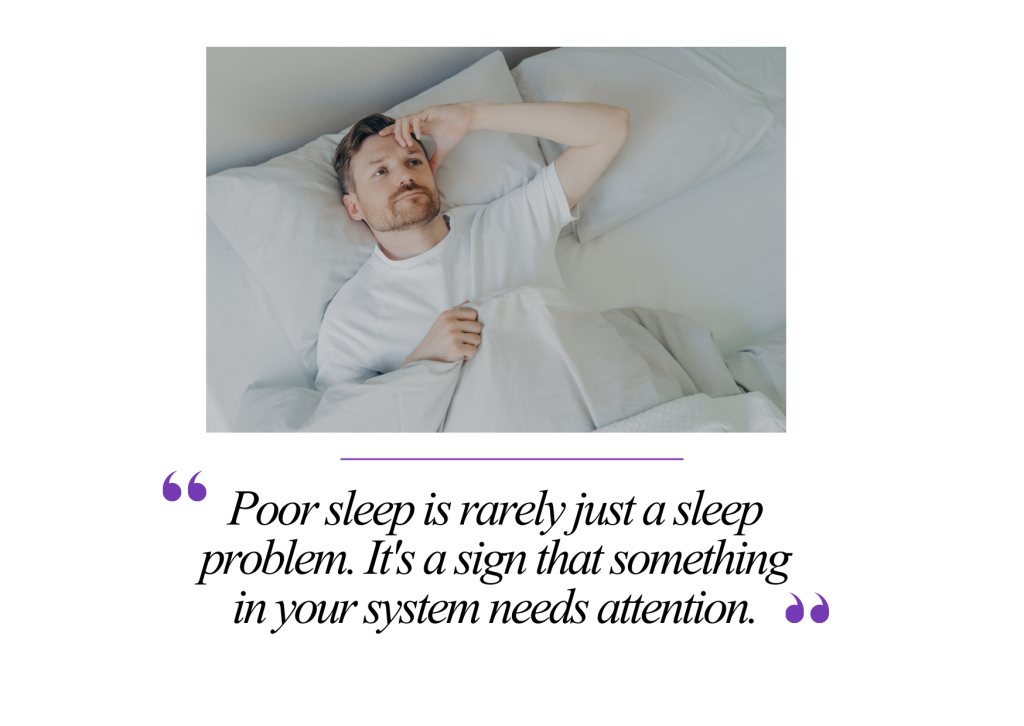
After more than 30 years working with leaders, high achievers, and people going through significant life change, I can tell you this with confidence: poor sleep is rarely just a sleep problem. It’s a sign that something in your system needs attention. The practical tips in this article will help – and I use most of them myself. But I want to start by explaining why sleep becomes disrupted in the first place, because once you understand that, everything else makes more sense.
Your nervous system doesn’t switch off just because you want it to
We carry a lot. Most of us carry far more than we realise – stress that hasn’t been processed, emotions that have been pushed down to get through the day, grief and worry and unresolved things that don’t go away just because we’re busy.
When we finally lie down and go quiet, that’s when the body tries to deal with all of it.
Research indicates that 75-90% of disease is stress-related. Our bodies store trapped emotions – they build up and affect us physically and psychosomatically. We were mostly raised to bury our feelings, not feel them. And at night, when the distractions are gone, the body tries to process what we haven’t dealt with during the day.
This is why deep emotional healing work – like Self Directed Healing (SDH), which I practise and teach – can produce dramatic improvements in sleep for people who have tried everything else. When you release the trapped emotional weight from your system, your nervous system genuinely calms down. Your mind and body stop running the background programs that were keeping you awake.
If you’re waking with panic attacks, anxiety, or nightmares – or if disrupted sleep has been with you for years – I’d really encourage you to explore that level of work. It gets to the root in a way that tips alone can’t.
In the meantime, here’s what actually helps.
The environment
Your bedroom matters more than most people realise.
Light and temperature first. Even the ambient glow of a clock or a standby light can affect your sleep quality. Get the room as dark as you can – a quality sleep mask is a simple, cheap fix if your curtains let light through. For temperature, aim for 18-20 degrees Celsius. Most people sleep too warm, so consider a lighter doona if you’re regularly waking hot.
Keep the bedroom for sleep (and enjoyment). Your mind needs to associate this space with rest. Working in the bedroom trains your brain to stay alert in a space it should associate with switching off. If you can, move the work out.
Phone out of reach. The blue light from screens actively suppresses melatonin – the hormone that regulates your sleep-wake cycle. Two hours before bed, off the devices where possible. And in the morning, give yourself at least an hour before picking the phone up. Start with 20 minutes and build from there. Most phones now have built-in blue light filter settings – use them. Blue-blocking glasses are also worth looking into if screens in the evenings are unavoidable.
The body
Exercise is one of the best sleep interventions there is. Studies suggest the optimal time is around 7:30am for sleep benefits, but any movement is better than none. Find what works for your schedule and do it consistently.
Hydration. Dehydration disrupts sleep – and paradoxically, it can increase the likelihood of waking during the night needing the bathroom. Drink well throughout the day. First thing in the morning, before anything else, drink a good glass of water. Your brain is approximately 80% water and dehydrates overnight.
Caffeine. Four or fewer caffeinated drinks per day, and ideally none after lunch. Most people underestimate how long caffeine stays active in their system.
Natural supports. Magnesium, valerian, certain herbal teas – there are genuinely useful natural options. Do your own research rather than relying on packaging claims. The Sleep Doctor (thesleepdoctor.com) is a solid, evidence-based resource.
Avoid sleeping tablets as a long-term solution. They don’t address what’s causing the disruption – they temporarily mask it. I understand why people reach for them when they’re desperate. But they’re a short bridge, not a destination.
The nervous system
This is where I spend the most time with clients, and where the biggest shifts happen.
The 4-7-8 breathing technique is something I use myself on nights when my mind is busy. Breathe in through your nose for 4 counts. Hold for 7. Breathe out through your mouth for 8. Repeat four times. It sounds simple – and it is – but the reason it works is that it shifts your focus entirely to your breath, which slows mental chatter and activates your parasympathetic nervous system. I often fall asleep doing it. It’s also excellent if you wake in the middle of the night and your thoughts start racing – bring yourself back to the breath, start the count, and let everything else wait.
Meditation and sleep meditations are worth building a small library of. Find a few you like and keep them accessible so you’re not searching when you’re already tired. There are hundreds of free options on YouTube and Spotify.
Track your sleep if you want to understand what’s actually happening. I use a Fitbit and find the sleep score invaluable – it measures deep sleep, REM, light sleep, restlessness, and oxygen variation. Once you have a baseline, you can start to notice what helps and what doesn’t. My personal goal is consistently above 82. When I drop below 80 for a couple of nights in a row, I feel it in my focus and energy – it’s an early warning signal that something needs attention.
The mindset piece
Pay attention to how you talk about your sleep.
‘I’m a terrible sleeper.’ ‘I never sleep well.’ ‘I always wake at 3am.’ These aren’t neutral observations – they’re instructions your brain takes seriously. Your internal dialogue shapes your experience more than most people realise.
Try shifting to: ‘I’m working on improving my sleep.’ ‘My sleep is getting better.’ ‘I’m learning to rest more deeply.’ This isn’t about pretending everything is fine. It’s about pointing your mind in the right direction instead of reinforcing the pattern you want to break.
Create a wind-down routine. What do you do in the hour before bed? If it’s screens and stimulation, that’s worth examining. A consistent routine – even a simple one – signals to your system that it’s time to start coming down. I’ve learned to listen to my body and go to bed when it tells me to, rather than pushing through for that bit longer.
Start somewhere, not everywhere
Don’t try to implement all of this at once. Pick two or three things that resonate and start there. Notice what shifts. Then come back and add more.
Small, consistent changes build momentum over time. Poor sleep patterns – even long-standing ones – can change. It’s totally possible. I’ve seen it in my own life and in the work I do with clients.
Your sleep affects everything: your mood, your relationships, your focus, your physical health, your emotional resilience. It’s not a luxury. It’s the foundation.

If you’d like support getting to the root of what’s keeping you awake, I’d love to chat.
Book a discovery call here.
Christy Roberts
Founder, Creating Change Network
2023 Australian Women’s Small Business Champion | President, The Compassionate Friends Victoria